What’s it all about
Fun fact: B2B buyers have more ways to research vendors than ever before, but that doesn’t mean they trust everything they find. Surely, reviews, case studies, social media, AI-generated summaries, peer recommendations, and sales conversations all contribute to the buying process. However, vendors face a challenge: these sources don’t carry the same level of credibility.
As a result, trust has become an important part of B2B buyer behavior. Buyers want evidence that a vendor understands their problem, can deliver what it promises, and has helped organizations with similar needs before. They also want to reduce the risk of making a decision that could affect budgets, operations, or their own professional reputation.
TrustRadius’ 2025 research found that 77% of technology buyers looked at user reviews during their buying journey, while 54% spoke with a user before purchasing a SaaS product. The same research found that buyers value prior experience, product demonstrations, user reviews, and conversations with peers because these sources help them build confidence in their decision.
This changes how companies should think about B2B trust signals. I mean, a trust signal is evidence that helps a buyer decide whether a vendor is worth considering.
What are B2B trust signals?
B2B trust signals are pieces of evidence that reduce uncertainty during the buying process. They can come directly from the vendor, from existing customers, from independent sources, or from the buyer’s own experience with a company or product.
Some of the most common B2B trust signals include:
- Customer reviews and ratings
- Case studies with specific results
- Customer references
- Peer recommendations
- Product demonstrations
- Transparent pricing
- Security and compliance information
- Relevant certifications
- Industry expertise
- Product documentation
- Customer logos
- Third-party research
- Consistent information across channels
- Evidence of successful implementations
- Recommendations from people the buyer already trusts
The important point is that trust signals work by reducing perceived risk. A buyer evaluating an unfamiliar vendor has questions that marketing copy alone cannot answer: “Has this company solved a similar problem? Can it deliver at the required scale? What happens during implementation? What are the limitations? Will the promised results actually materialize?”
To cut a long story short, the stronger the evidence available to answer those questions, the easier it becomes for the buyer to move forward.
Why trust has become a buying factor
B2B purchasing decisions have become increasingly self-directed. Buyers can research vendors long before speaking to a salesperson, compare alternatives independently, and ask colleagues or industry peers about their experiences.
Gartner’s 2025 research claims that 83% of buyers change their initial vendor lineup during the buying process. The shortlist therefore remains fluid as buyers gather more information and reassess their options. Gartner also found that 90% of buyers say social proof heavily influences their shortlist decisions.
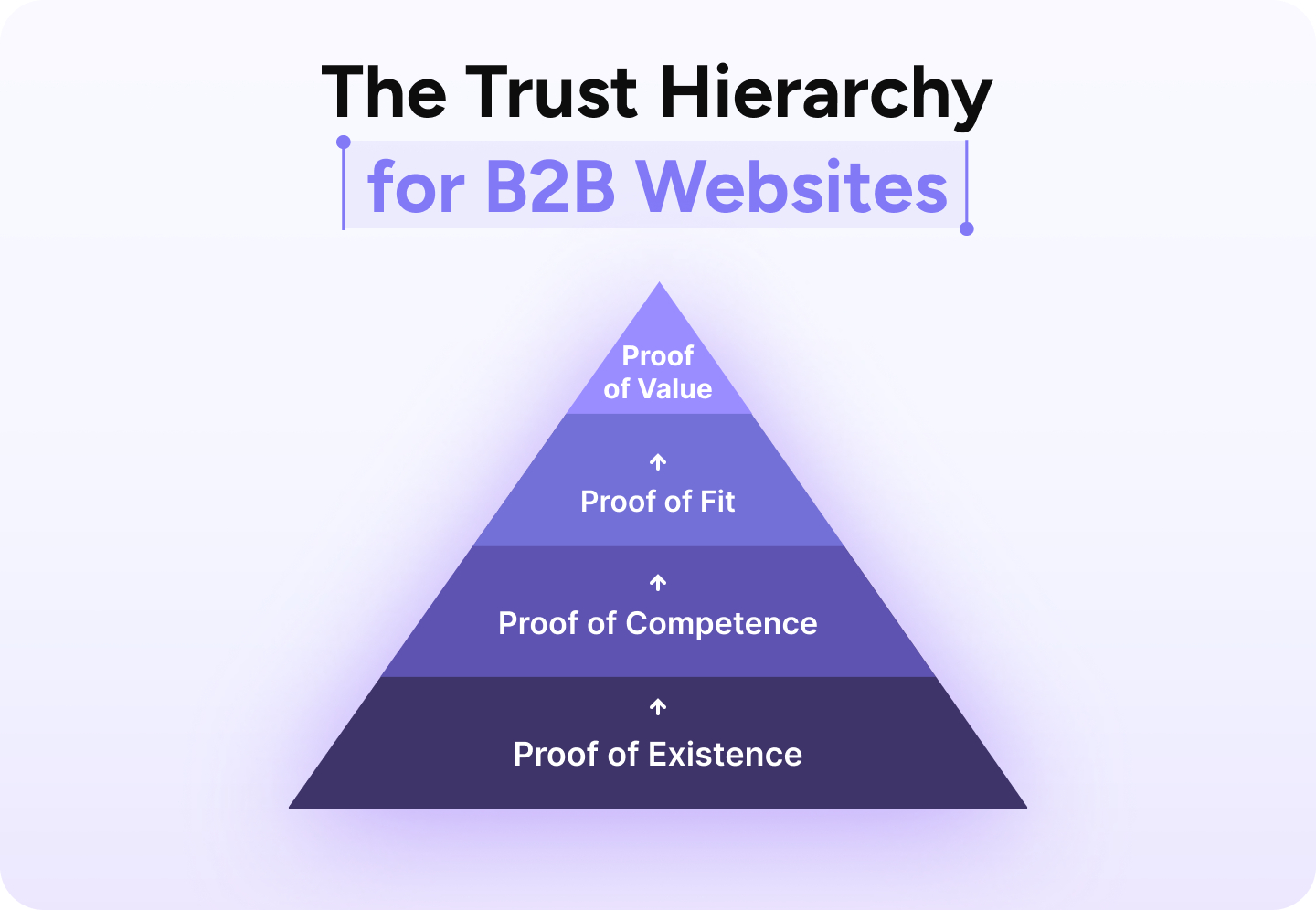
This makes credibility particularly important before a sales conversation begins. A company may have a strong product and a good sales team, but buyers can remove it from consideration before either becomes relevant.
What’s more, trust is also connected to professional risk. Choosing a B2B vendor is rarely a purely personal decision, to be honest. The buyer may have to explain the purchase to a manager, finance team, IT department, procurement team, or other members of the buying group. Evidence from customers and peers gives buyers something more useful than a marketing claim: external validation that the decision is reasonable.
Buyers don’t trust every signal equally
One of the biggest mistakes in B2B marketing you can make is treating every trust signal as equally valuable. A company logo on a website, for example, can show that a relationship exists, but it does not tell a prospective buyer much about the quality of that relationship.
A detailed customer review from someone with a similar role, company size, industry, and use case is much more useful. It gives the buyer a point of comparison. The buyer can evaluate not only what the customer liked, but also what problems they encountered and what results they achieved.
This is one reason why specific evidence tends to outperform generic credibility claims. I mean, the “Trusted by leading companies” motto says very little. A customer explaining how a vendor reduced implementation time, solved a particular technical problem, or helped a team achieve a measurable business outcome provides much more useful information.
Key takeaway
Buyers looking at review sites value qualitative review content and reviewers they can relate to, along with practical information such as product demonstrations and pricing.
Customer reviews are powerful trust signals
As of today, customer reviews have become one of the most important forms of B2B social proof. They provide information that vendors have less control over than their own websites and marketing materials, which can make them particularly useful during vendor evaluation.
The value of reviews also comes from their ability to expose limitations. A polished case study usually focuses on a successful outcome. Reviews can provide a broader picture, including implementation difficulties, product limitations, support experiences, and situations where a solution may not be appropriate.
Key takeaway
In all fairness, that information can actually strengthen B2B buyer trust. Believe me: buyers don’t necessarily expect a product to be perfect, they want to understand what they are getting into.
Social proof works because it reduces uncertainty
B2B social proof works for a straightforward reason: other people’s experiences provide context for a decision that may otherwise feel uncertain. A buyer considering an unfamiliar software platform, consulting firm, or technology provider has limited direct evidence. They can read the vendor’s website, but the vendor naturally controls that information. Customer experiences provide another perspective.
Peer recommendations can be particularly influential because they come from people who may understand the buyer’s situation. A recommendation from another executive, technical leader, or practitioner can answer questions that a generic marketing page cannot.
Key takeaway
This is why customer references, reviews, communities, professional networks, and industry conversations remain important parts of the B2B buying process. Buyers are not simply looking for positive opinions. They are looking for evidence that the vendor has worked successfully in circumstances similar to their own.
Case studies still matter (but they need evidence)
Case studies remain one of the strongest B2B credibility tools, particularly when they provide specific information about the original problem, implementation, and business outcome.
The problem is that many case studies are written as promotional stories. They describe a challenge, introduce the vendor’s solution, and conclude with vague statements about improved efficiency or customer satisfaction. This makes them less useful as buyer evidence.
A stronger case study gives buyers enough detail to judge relevance. It explains what the customer was trying to accomplish, what constraints existed, why a particular approach was selected, and what changed after implementation.
Key takeaway
Sure thing, numbers can help, but they are not mandatory. A clear explanation of the problem and solution can be just as valuable when precise financial results cannot be disclosed. The goal is to help another buyer recognize their own situation in the story.
Expertise is more credible when it is specific
Expertise is another important B2B trust signal, but simply claiming expertise has limited value. Most vendors describe themselves as experienced, knowledgeable, innovative, or industry-focused.
Buyers have learned to look for evidence behind those claims. Specific expertise is easier to evaluate. A company that regularly publishes detailed analysis of a particular technology, explains real implementation challenges, shares technical lessons, or discusses industry-specific problems demonstrates knowledge through its work.
In fact, the same applies to individual experts. A technical leader who explains how a particular architecture decision affects scalability is more credible than someone who repeatedly describes themselves as a technology expert. In B2B marketing, expertise becomes a trust signal when buyers can observe it.
Buyers are researching without sales
The growth of self-service research makes trust signals particularly important before a sales conversation begins. Buyers can compare products, read reviews, watch demonstrations, research competitors, ask colleagues, and investigate vendors independently. In reality, B2B technology buyers spend most of their time with vendor digital sources while still placing greater trust in some human interactions.
This creates a difficult balance for sales and marketing teams. Buyers want control over the early stages of the process, but they still need people when they reach questions that require context, judgment, or validation.
Key takeaway
The implication is that vendors shouldn’t treat sales as the first place where trust is created. The website, content, customer evidence, product experience, reviews, and other digital touchpoints should already give buyers enough confidence to continue. For B2B companies, this means investing in evidence is usually more valuable than simply producing more claims.
Trust signals also change by buying stage
The most useful trust signal depends on where the buyer is in the B2B buying process. Early-stage buyers may want to understand whether a vendor is credible and whether the category is relevant to their problem. At this point, search visibility, industry content, customer reviews, and peer recommendations can help establish initial confidence.
During evaluation, buyers usually need more specific evidence. Product demonstrations, technical documentation, case studies, implementation information, security details, and conversations with existing customers can become more important.
Near the final decision, the questions often become more practical. Buyers may want references, pricing clarity, contract information, implementation plans, service-level commitments, or proof that the vendor can support their specific requirements. A strong B2B trust strategy therefore doesn’t depend on one asset, but gives buyers the evidence they need at different points in the buying process.
Trust signals and buyer intent
This is where B2B trust signals connect with buyer intent and sales intelligence. Trust is usually discussed as something marketing teams build, while intent is often treated as something sales teams detect. In reality, the two are closely connected.
Let’s suppose a company has strong customer reviews, credible case studies, and an established reputation. That establishes baseline vendor credibility, true. However, it doesn’t necessarily mean the company is relevant to a particular account today.
Now suppose that account has started hiring for capabilities related to the vendor’s solution, launched a relevant product, changed its technology strategy, or expanded into a new market. Those changes can provide context for why the vendor may be relevant now.
Buyer intent signals help sales teams identify that change. Trust signals help the buyer evaluate whether the vendor deserves consideration once that relevance has been established. The combination is more useful than either one alone. Sales intelligence can identify an emerging opportunity, while credible evidence gives the buyer a reason to engage.
How to build a stronger B2B trust strategy
Companies do not need hundreds of trust assets. They need evidence that answers the questions buyers actually have.
A practical B2B trust strategy should focus on several areas:
- Collect real customer evidence. Encourage customers to leave detailed reviews and participate in references or case studies.
- Make proof specific. Explain the problem, solution, context, and outcome instead of relying on generic success claims.
- Show limitations. Acknowledging where a product or service may not be suitable can make other claims more credible.
- Provide useful self-service information. Buyers should be able to find pricing guidance, product information, security details, documentation, and customer evidence without immediately entering a sales process.
- Keep information consistent. Check whether websites, sales materials, product pages, reviews, and other channels communicate the same core facts.
- Demonstrate expertise. Publish practical insights that show how the company approaches real problems.
- Connect trust with relevance. Use account intelligence and buyer intent signals to understand when a particular solution may become relevant to an account.
- Give sales teams context. Instead of simply telling salespeople which accounts to contact, explain what changed and why that change may matter.
This approach turns trust from a branding exercise into part of the buying experience.
How TrajectoryAI helps identify the right accounts
TrajectoryAI helps revenue teams understand which accounts are becoming more relevant instead of relying exclusively on static account lists or generic ICP criteria. The platform monitors changes across companies and connects signals such as hiring, leadership changes, product launches, expansion, funding, technology activity, and other business events.
That context also helps make outreach more credible. Instead of approaching a company simply because it matches an ideal customer profile, sales teams can identify a specific change that may indicate a new business priority.
In fact, the distinction matters. An account can be a perfect ICP fit and still have no reason to engage with a particular vendor today. Another account may have become significantly more relevant because something changed inside the business. By combining account intelligence, buyer intent signals, competitive intelligence, and opportunity detection, revenue teams can focus on accounts where relevance appears to be increasing.
Have you tried TrajectoryAI yet? Start your trial today and discover how AI can help you identify high-intent accounts before your competitors do.
The future of B2B trust is evidence-based
B2B buyers won’t be researching vendors independently. If anything, AI and easier access to information will give them more ways to investigate companies before engaging with sales.
I guess that means the volume of content a company produces will become less important than the quality and credibility of the evidence behind it. Buyers can already generate summaries, compare vendors, ask AI tools questions, and search across multiple sources. What they need from vendors is information they can validate:
- Customer experiences
- Detailed reviews
- Specific case studies
- Transparent pricing
- Product demonstrations
- Technical evidence
- Credible expertise
- Consistent communication
All these factors contribute to that confidence.At the same time, trust cannot compensate for poor timing. A highly credible vendor may still be irrelevant if there is no current need. This is why trust signals and buyer intent should be viewed together. The companies that perform well in this environment will make it easy for buyers to answer two questions: “Can I trust this vendor? And why should I consider it now?”
Summing up
In my experience, B2B trust is built through evidence rather than claims. Buyers want to understand what other customers experienced, whether the vendor can solve problems similar to theirs, what risks they should expect, and whether the company can deliver on its promises.
The most useful trust signals tend to be specific, verifiable, and relevant to the buyer’s situation. Reviews, peer recommendations, case studies, product demonstrations, transparent pricing, security information, and practical expertise can all contribute to buyer confidence.
At the same time, trust is becoming increasingly connected to relevance. Buyers have limited attention and can research vendors independently, so generic credibility is no longer enough. Sales and marketing teams need to understand what is changing inside target accounts and why those changes may create a reason to engage. Thus, the goal is to give them enough credible evidence to reach that conclusion themselves.