What’s it all about
Account-based marketing has long been one of the most effective ways for B2B companies to focus sales and marketing resources on high-value accounts. Instead of generating as many leads as possible, an account-based marketing strategy starts with a defined set of companies that fit the ideal customer profile (ICP), then coordinates marketing and sales activity around them.
The problem is that the market around those accounts has changed. B2B buyers are exposed to more vendors, content, advertising, and sales outreach than ever. Buying groups are also larger and less predictable. An account that looked like a perfect target six months ago may have no active buying project today, while another company that was previously ignored may suddenly be hiring, expanding, changing technology, or researching a new solution.
This creates a fundamental problem for traditional ABM, and the answer is to make account-based marketing more dynamic.
What traditional ABM gets right
Before looking at its limitations, it is worth acknowledging why ABM became popular in the first place. Traditional ABM solves a real problem in B2B sales: not every company deserves the same amount of attention.
A software company selling a complex enterprise platform may have thousands of potential businesses it could theoretically approach. A sales team cannot build meaningful relationships with all of them. ABM narrows the field by identifying accounts that are more likely to become valuable customers.
Demand Gen Report’s found that 67% of practitioners currently use an ABM strategy, while another 26% planned to add one. A typical ABM strategy uses factors such as:
- Industry
- Company size
- Revenue
- Geography
- Technology stack
- Existing customer relationships
- Business model
- Potential contract value
- Historical engagement
- Strategic importance
These factors help create an ideal customer profile and a target account list.
The approach also encourages sales and marketing alignment. Both teams can work from the same list, coordinate campaigns, and agree on which accounts deserve additional resources.
Don’t get me wrong, that remains valuable. The problem starts when companies treat the target account list as a conclusion rather than a starting point. I mean, an account can fit your ICP perfectly and still have absolutely no reason to talk to you today.
The biggest problem: fit is not timing
This is where many ABM challenges begin. Firmographic and technographic data can tell you whether an account looks like a good customer. However, they can’t reliably tell you whether the company is currently evaluating a solution.
Let’s imagine a technology company selling cybersecurity services, shall we? Its ideal customer might be a financial services company with 500 to 5.000 employees, operations across several markets, and a complex technology environment.
There may be hundreds of companies that fit this profile. Traditional ABM can help identify them and divide them into tiers. But suppose only 20 of those companies are actively considering a сybersecurity project this quarter. The other 180 may still be excellent prospects, but they simply are not equally relevant at the same moment.
Treating all 200 accounts as active targets creates several problems:
- Sales representatives spend time contacting companies with no immediate need.
- Marketing spends money keeping inactive accounts engaged.
- Personalized campaigns are created for buyers who may not even have a project under consideration.
Research and industry analysis increasingly distinguish ICP scoring from buyer intent data for exactly this reason. ICP scoring measures whether an account resembles your ideal customer, while intent signals provide clues about whether it is actively researching a relevant problem. In other words: fit tells you where you could win, and signals help indicate where something may be happening now.
Static account lists become less useful over time
In all fairness, a target account list isn’t necessarily wrong because it is static. It becomes a problem when nothing updates it.
Markets change continuously. Yet many B2B account-based marketing programs still operate around lists that were created at the beginning of a quarter or campaign, and that creates a timing gap.
A company might enter your target account list in January because it matches your ICP. By, say, April, nothing may have changed. Meanwhile, another company outside the original list may have started hiring engineers, launched a new product, and expanded into a market where your solution is highly relevant.
Your sales team is still working through January’s priorities, but the market has already moved on. This is one reason account prioritization needs to become dynamic. Current research and industry guidance increasingly recommend using intent and other account-level signals to re-tier accounts rather than relying exclusively on fixed lists.
Crowded markets make generic personalization less effective
In fact, traditional ABM is often associated with personalization, and that makes sense. If you know the account, you should be able to create more relevant messaging. But personalization has become easier to produce.
AI tools can generate account-specific emails, landing pages, LinkedIn messages, and sales copy at a scale that was difficult to achieve a few years ago. As more companies adopt these tools, simply mentioning a prospect’s company, industry, or recent announcement no longer creates much differentiation.
The result is an uncomfortable paradox. I mean, the more scalable personalization becomes, the less personalized it can feel. This is why B2B buyer behavior matters as much as account characteristics.
The important question is “What is happening inside this account that could make our solution relevant?” That shift moves ABM from profile-based targeting toward signal-based prioritization.
More accounts can (quietly) destroy ABM
Another problem appears when companies try to scale ABM too aggressively. Sure thing, ABM works partly because it promises focus. But companies often respond to pressure for pipe by expanding their target account list.
A list of 50 strategic accounts becomes 200, 500, then 1.000. Eventually, almost every company that fits the ICP becomes a “priority account.” At that point, the word priority has stopped meaning much.
A sales representative with 100 target accounts cannot realistically provide the same level of attention to every company. Marketing cannot create meaningful account-specific experiences for all of them either.
This creates what could be called ABM dilution. The business keeps the terminology and technology of ABM while gradually returning to broad-based marketing with a narrower audience.
Pro tip
The biggest issue here is the lack of a mechanism for determining which accounts deserve more attention at a particular moment. Thus, modern ABM needs a stronger connection between account prioritization, buying signals, and sales action.
Buyer intent data changes the question
This is where buyer intent data becomes useful. Intent data doesn’t “magically” reveal which company will buy from you, and it should not be treated as proof of purchase intent either. Instead, it provides additional behavioral evidence that can help sales and marketing understand which accounts may be becoming more active.
Examples of useful buyer intent signals can include:
- Increased research around a relevant topic
- Visits to product or pricing pages
- Competitor comparisons
- Multiple people from the same company researching a category
- New job openings related to a technology or business initiative
- Product launches
- Leadership changes
- Funding events
- Geographic expansion
- Technology changes
- New partnerships
- Public statements about strategic priorities
The value comes from combining these signals with account fit:
- An account with strong ICP fit but no relevant activity may remain a long-term prospect.
- An account with strong ICP fit and several recent signals may deserve immediate attention.
- An account with weak ICP fit but one isolated signal should probably not suddenly become Tier 1.
That is why intent data in ABM should support prioritization rather than replace judgment.
ABM needs dynamic account prioritization
The next evolution of account-based marketing strategy is therefore less about creating the perfect list and more about continuously deciding where attention should go.
Let’s consider a simple model: account priority = fit + relevance + recent signals + buying activity. The exact scoring methodology will vary by business. The important point is that account priority should be capable of changing. A company that was Tier 3 last month can become Tier 1 when several meaningful signals appear.
Likewise, an account that received heavy attention last quarter can move down the list when activity disappears. This creates dynamic account prioritization.
Key takeaway
Instead of asking sales representatives to work through a fixed sequence, the system helps them understand which accounts deserve attention now. This is particularly important in crowded markets because the competitive advantage is identifying meaningful changes earlier.
The signals need context
There is a danger of going too far in the opposite direction. Once teams discover intent data, it can be tempting to treat every signal as an urgent buying opportunity. Unfortunately, that creates another form of noise.
For instance, someone downloading an article does not necessarily mean their company is buying software, or, say, a single employee visiting a competitor’s website does not prove that a buying committee exists. I mean, buyer intent data works best as a layer of evidence, not as a magic “ready to buy” button.
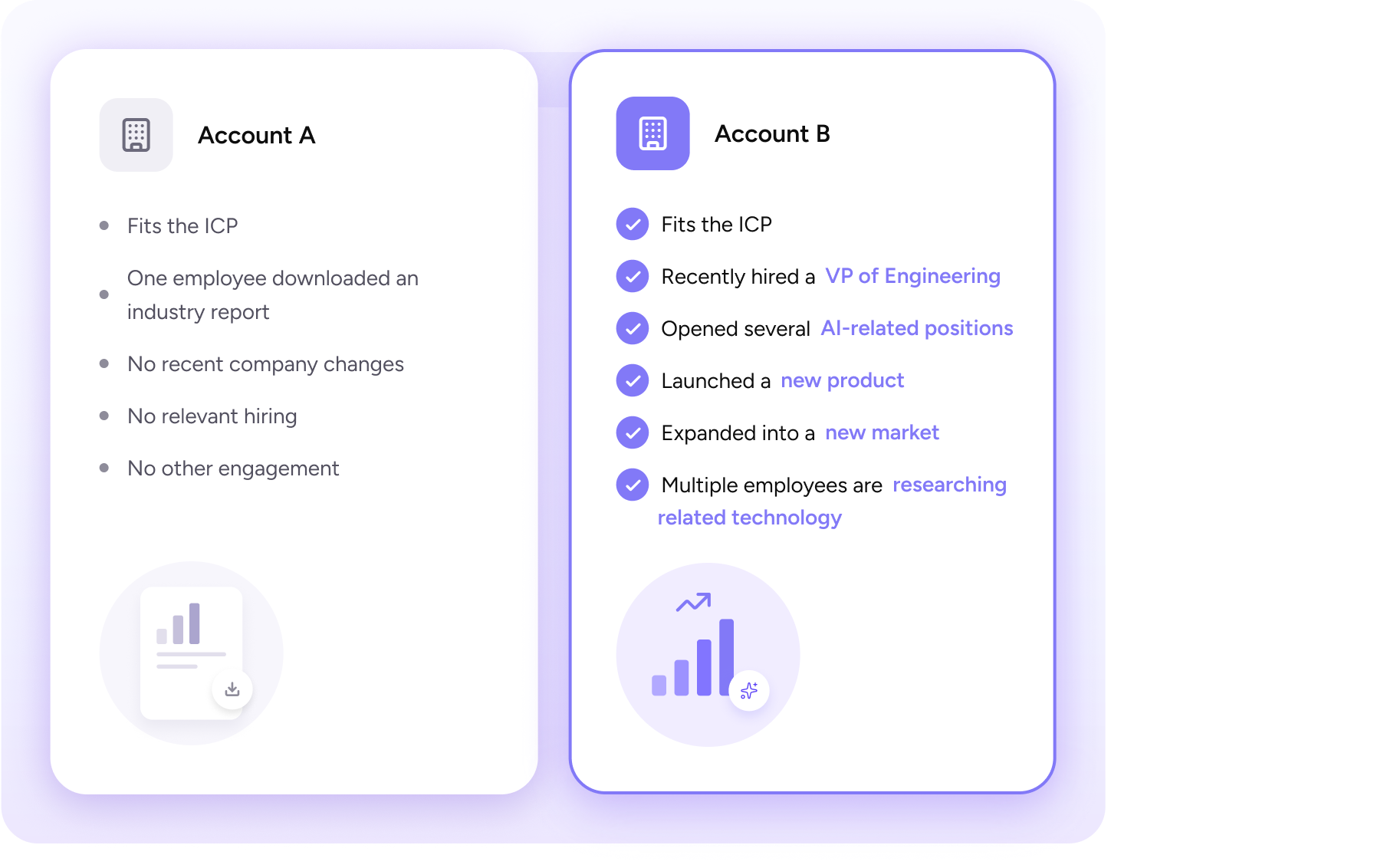
Context is what makes signals useful. For example, consider these two accounts:
Key takeaway
Both may receive the same traditional ABM score, but they should not receive the same sales priority. Account B has a developing business story. The individual signals become more meaningful when viewed together. That is the difference between collecting data and building account intelligence.
Traditional ABM often doesn’t see the change
One of the deeper limitations of traditional ABM is that it tends to describe accounts as they are. Modern B2B sales need to understand how accounts are changing.
A company profile might tell you:
- 800 employees
- SaaS company
- $100M revenue
- Europe and North America
- Uses a particular cloud platform
That information is useful, but it is largely static. A signal-based approach adds another layer:
- Headcount increased 18% in six months
- Company opened a new office
- New CTO joined
- Five AI engineering roles appeared
- Product expansion announced
- Competitor partnership ended
- New funding announced
Now you have a developing picture of the account. This is especially valuable for competitive intelligence because changes in a company can reveal opportunities before they appear in a conventional lead or CRM record.
Pro tip
Don’t monitor companies for the sake of monitoring them. Instead, identify changes that can alter the probability of commercial relevance.
From target account lists to opportunity detection
This leads to a broader shift in how revenue teams think about ABM. Traditional ABM asks: ‘Which accounts should we target?” A more dynamic model asks: “Which accounts are becoming more relevant, and what changed?”
What does it mean? Well, the first question produces a list, the second produces opportunities. This distinction is important because most companies already have plenty of potential accounts. Their problem is deciding where to spend limited sales and marketing attention.
An account may become interesting because of a funding event, another may become relevant because of rapid hiring, and a third may be responding to competitive pressure. These events can create windows of opportunity. In other words, the earlier a revenue team recognizes the change, the more time it has to develop a relevant approach.
This is where sales intelligence and competitive intelligence can strengthen ABM. Instead of relying exclusively on CRM history and static firmographic information, teams can combine account data with external signals to identify changes that matter commercially.
What a modern ABM strategy should look like
Let me emphasize: traditional ABM should be thrown away. The stronger approach is to keep its useful foundation and add a dynamic intelligence layer. A practical ABM strategy can follow five stages.
1. Define the ICP
Start with the fundamentals. Identify the industries, company sizes, business models, technologies, and other characteristics associated with successful customers. The ICP remains essential because signals without fit can create noise.
2. Build a target account universe
Create a broader pool of accounts that could potentially fit the business. Do not assume that every account in this universe deserves the same amount of attention.
This is where many traditional ABM programs go wrong. The target list becomes a permanent priority list. It should instead become a pool from which priorities can change.
3. Add current signals
Monitor events and behaviors that can indicate changing relevance. These can include:
- Hiring activity
- Leadership changes
- Product launches
- Funding
- Expansion
- Technology changes
- Relevant content research
- Competitor activity
- Market moves
- Changes in strategic direction
The exact signals should reflect the product and buying process.
4. Reprioritize continuously
Use new information to adjust account tiers:
- An account showing several relevant signals can move up.
- An account with no meaningful activity can move down.
This prevents sales teams from spending equal effort on accounts with radically different levels of current opportunity.
5. Connect signals to action
This final step is often overlooked: a signal is valuable only when someone can do something useful with it. If a company announces expansion into a new market, for example, the appropriate response might be research, executive outreach, relevant content, or a conversation with an existing contact.
Don’t send an automated message every time something happens. The goal is to give sales and marketing teams better reasons to decide where to focus and what to investigate.
How TrajectoryAI helps modernize ABM
TrajectoryAI approaches account intelligence from this dynamic perspective. Instead of treating an account list as a fixed collection of prospects, the platform helps teams track what is changing across the companies that matter to them.
Its AI-powered sales intelligence combines company information with signals such as hiring, leadership changes, product launches, funding, expansion and other relevant business events. This gives sales and marketing teams a way to identify emerging opportunities rather than relying entirely on static account scores.
That can make account prioritization more responsive. For teams using competitive intelligence, this also creates a useful connection between market monitoring and sales execution. Instead of keeping competitive research separate from revenue activity, teams can use changes in company behavior to identify accounts that may warrant attention.
Have you tried TrajectoryAI yet? Start your trial today and discover how AI can help you identify high-intent accounts before your competitors do.
The future of ABM is more dynamic
Traditional ABM remains useful because focus remains useful. The problem is assuming that the accounts worth focusing on today will remain equally important tomorrow.
In crowded B2B markets, priorities change too quickly for a static target account list to tell the whole story. Companies evolve, buying groups change, competitors move, and new opportunities emerge outside the original plan.
The next generation of account-based marketing will therefore depend less on building increasingly sophisticated lists and more on understanding what is changing inside those accounts.
Key takeaway
The strongest ABM programs will still care about ICP fit, personalization, and sales-marketing alignment. But they will add another question to the process: “Why this account, and why now?”
That question brings ABM closer to real-world buying behavior, and when every vendor is competing for the same limited buyer attention, knowing where to focus now may be more valuable than having the largest target account list.
Summing up
Okay, now let’s sum things up:
- Traditional ABM is strong at identifying accounts that fit a company’s ideal customer profile, but weaker at identifying which accounts are becoming relevant now.
- ICP fit and buyer intent are different signals. One describes potential fit, while the other can provide evidence of current research or activity.
- Static account lists can become outdated as companies change their strategies, leadership, technology, hiring and market focus.
- Dynamic account prioritization helps sales teams adjust their focus as new signals emerge.
- Buyer intent data should be treated as evidence that informs prioritization, not as automatic proof that an account is ready to buy.
- Competitive intelligence and sales intelligence can add context to account-level changes that traditional ABM may miss.
- Modern B2B account-based marketing should focus not only on which accounts fit, but on which accounts are changing in ways that create potential opportunities.